Forget the Report Card: The Social Skills That Will Actually Determine Your Child's Future
The Skill Nobody Talks About at Parent-Teacher Conferences
Every fall, parents across the country sit down for parent-teacher conferences armed with the same anxious questions: Is my child reading at grade level? Are their math scores where they should be? And those things matter—nobody's saying they don't. But there's a whole category of skills that rarely makes it onto a report card, and according to a growing body of research, it might be the most important predictor of how well your child actually does in life.
We're talking about emotional intelligence—specifically, the ability to navigate conflict, tolerate frustration, and advocate for yourself without melting down or shutting down entirely.
At Salisbury Day Care & OSC, we see these skills in action every single day. And honestly? Watching a five-year-old figure out how to work through a disagreement over who gets the red crayon is one of the most fascinating things you'll ever witness.
Why Conflict Isn't the Problem—Avoiding It Is
Here's something that might feel counterintuitive: conflict among children is actually a good thing. Not the kind where someone ends up crying and another kid is hiding behind a bookshelf, but the everyday friction that comes from sharing space, resources, and attention with other people.
When kids bump up against each other's wants and needs, they're getting a live, unscripted education in emotional regulation. Research from organizations like the Yale Center for Emotional Intelligence has consistently found that children who learn to manage conflict constructively in early childhood show better outcomes in school, stronger friendships, and even higher earning potential as adults—regardless of their academic performance.
That's not a small thing. That's kind of everything.
The problem is that many well-meaning adults—parents, caregivers, teachers—reflexively step in to smooth things over before kids ever get the chance to work through the discomfort themselves. It's understandable. Nobody likes watching a child struggle. But that struggle is actually where the learning lives.
What It Looks Like in a Group Care Setting
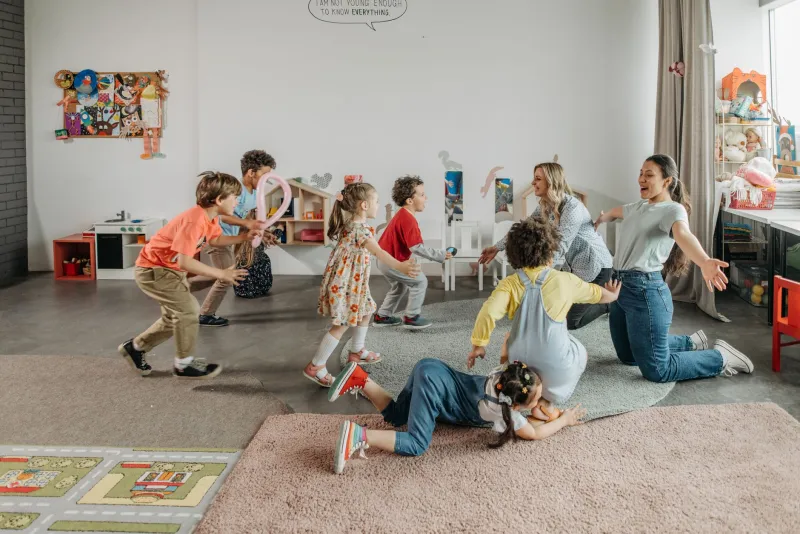
In a structured out-of-school care environment, conflict is practically a daily curriculum item—just not one you'll find on any official lesson plan.
Consider a scenario that plays out regularly in group care: Two kids both want to be the leader during a game. Voices get louder. Someone crosses their arms. Someone else starts to cry. A staff member doesn't immediately assign a leader. Instead, they crouch down and ask, "What's going on? How do you each feel right now?"
That single question does more developmental work than most people realize. It asks children to pause, identify an emotion, and articulate it out loud. That's hard for adults, let alone seven-year-olds.
From there, the process continues: What do you both want? Is there a way for both of you to get some of what you want? What could that look like?
The kids don't always land on a great solution. Sometimes the whole thing falls apart and everyone needs a break. But over time—over hundreds of these small interactions across weeks and months—something remarkable happens. Children start to internalize the process. They begin pausing before reacting. They start using words like "frustrated" and "left out" instead of just screaming or storming off.
That's emotional intelligence being built in real time.
The Frustration Tolerance Factor
One piece of conflict resolution that doesn't get enough attention is frustration tolerance—the ability to sit with something being hard or unfair without completely unraveling.
Kids who struggle with frustration tolerance tend to give up quickly on challenging tasks, lash out when things don't go their way, and have a harder time forming stable friendships. None of that is a character flaw. It's a skill gap, and like any skill gap, it can be addressed.
Group care settings are uniquely positioned to work on this because they create natural, low-stakes opportunities for frustration every day. A puzzle that's too hard. A game where you don't win. A project that doesn't turn out the way you imagined. In a supportive environment, those moments become practice rounds for bigger challenges down the road.
Staff at quality childcare programs learn to coach kids through these moments rather than rescue them from the feelings—a distinction that sounds small but makes an enormous difference.
Self-Advocacy: Teaching Kids to Speak Up for Themselves
There's a third piece of this puzzle that often gets overlooked: self-advocacy. The ability to say, clearly and calmly, "I don't like that," or "I need help," or "That doesn't feel fair to me."
Self-advocacy is the bridge between internal emotional awareness and external action. Kids who develop it early are more likely to seek help when they're struggling academically, set appropriate boundaries in relationships, and navigate workplace dynamics as adults.
In group care, self-advocacy gets practiced during snack negotiations, during group project disagreements, during moments when a child feels overlooked or misunderstood. Caregivers who are trained to listen and respond—rather than dismiss or override—are giving kids the message that their voice matters. That message sticks.
Bringing It Home: What Parents Can Do
You don't have to wait for the next group activity to reinforce these skills. Here are a few practical ways to keep the momentum going at home:
Let disagreements breathe. When your kids argue, resist the urge to immediately referee. Give them a few minutes to try working it out. You can stay close, but let them attempt the process first.
Name emotions out loud yourself. When you're frustrated in traffic or disappointed about something, say so. "I'm feeling pretty annoyed right now, so I'm going to take a breath before I respond." Kids learn emotional vocabulary by hearing it modeled.
Ask better questions after hard moments. Instead of "What happened?" try "How did that make you feel?" and "What do you wish had gone differently?" These questions build reflection skills over time.
Validate before you fix. When your child comes home upset about a conflict with a friend, your first instinct might be to solve it. Try validating the feeling first: "That sounds really frustrating. I get why you're upset." Then ask if they want help thinking through what to do next.
The Bigger Picture
Academic skills are real and they matter. We're not here to dismiss them. But the research is increasingly clear: kids who know how to manage their emotions, work through conflict, and advocate for themselves are better positioned for success in school, in relationships, and in the workforce—regardless of what their test scores look like.
At Salisbury Day Care & OSC, we think about this every single day. Because nurturing minds isn't just about what kids know. It's about who they're becoming.