Little Anchors, Big Calm: The Everyday Rituals That Help Kids Switch Gears Without Falling Apart
If you've ever watched a child completely unravel the moment they step through a door—any door—you already know that transitions are hard. Not just for toddlers. Not just for kids going through something tough. For pretty much every child, every single day.
What's less talked about is the fix. Not a big, structural overhaul of your family's schedule. Not a parenting book's worth of new strategies. Just small, repeatable moments—rituals, really—that give kids something to grab onto when the emotional ground shifts beneath them.
At Salisbury Day Care & OSC, we see the power of these micro-moments every single afternoon. And the research behind them is genuinely worth understanding.
Why Transitions Hit Kids So Hard in the First Place
Think about what a child's day actually looks like. They wake up at home—one emotional environment with its own rules, rhythms, and relationships. Then they go to school, which demands a completely different version of themselves: focused, rule-following, socially navigating a room full of peers. Then they come to after-school care, another environment with its own norms. And then, finally, home again.
That's three to four full context switches in a single day. For adults, even one major context switch—say, leaving a high-pressure work meeting and immediately walking into a family dinner—can feel jarring. For a child whose prefrontal cortex (the part of the brain that manages emotional regulation) is still very much under construction, it's genuinely taxing.
Neuroscience tells us that the brain craves predictability. When it can anticipate what comes next, it uses less energy managing uncertainty and has more resources available for actual engagement—learning, connecting, playing. When the next step is unclear or feels abrupt, the nervous system kicks into a low-grade stress response. That's not drama. That's biology.
What a Ritual Actually Does (It's Not What You Think)
The word "ritual" might sound formal, but we're not talking about elaborate ceremonies. A ritual, in this context, is just a small, consistent action that signals a shift. It's a bridge between one state and another.
For kids, these anchoring moments serve a specific neurological purpose: they activate the brain's sense of familiarity and safety, which in turn dials down the stress response before it has a chance to escalate. Think of it as a soft landing.
Research on predictability and child development consistently shows that children who experience consistent transitional cues—whether that's a specific greeting, a snack routine, or even a familiar song—demonstrate better emotional regulation over time. Not just in the moment, but cumulatively. The more a child practices moving through transitions smoothly, the more resilient they become at handling change in general.
The Rituals That Actually Work
So what do these look like in practice? Here are a few that show up in the research—and that we've seen make a real difference in our own programs.
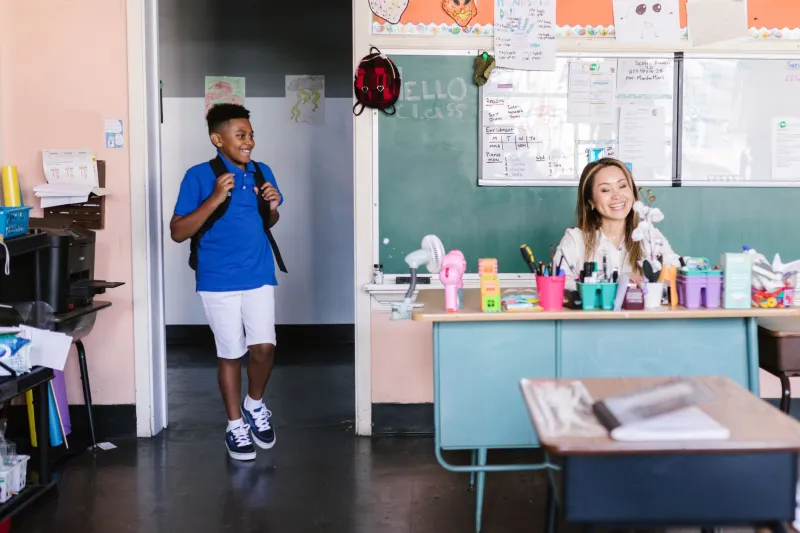
The Greeting Ritual A consistent, personalized hello at pickup or drop-off does more than you'd think. When a caregiver greets a child by name, makes eye contact, and uses a familiar phrase or gesture, it signals: you're known here, you're safe here. It's a small act, but it's a powerful one. Even a specific handshake or a running joke between a child and their after-school teacher can serve this function.
The Snack Anchor Food has a grounding quality that goes beyond nutrition. A predictable snack at the same time each day gives kids a sensory and routine anchor. It's not just about hunger—it's about the reassurance of "this is what happens next." At our program, snack time isn't just refueling. It's a built-in decompression window.
The "Brain Dump" Transition Some kids need a verbal release before they can settle. A simple, low-pressure check-in—"What was one good thing and one hard thing today?"—gives children a structured way to offload the emotional weight of the school day before they're expected to shift into the next mode. It doesn't need to be long. Two minutes can be enough.
The Physical Reset For kids who carry stress in their bodies (which is most of them), a brief physical activity right after a transition helps metabolize the cortisol that built up during the day. A short walk, five minutes of free movement, even stretching—these aren't just nice extras. They're physiological reset buttons.
The Goodbye Ritual Pickup is its own transition, and it's often the most emotionally loaded one. A consistent goodbye routine between a child and their care provider—even something as simple as a specific wave or phrase—helps close the loop on that environment cleanly. It gives the child permission to fully arrive somewhere new.
What Parents Can Do at Home
The beauty of transition rituals is that they don't require any special training or equipment. They just require consistency.
At home, the most effective thing parents can do is create a predictable "landing sequence" for when kids arrive. This might mean: shoes off, snack on the table, fifteen minutes of quiet time before any conversation about homework or the day. Or it might mean a specific hello hug and a question you always ask. The content matters less than the consistency.
It also helps to give kids a heads-up before transitions happen. "In five minutes, we're leaving care" is less disruptive than a sudden "Let's go." That small warning gives the brain time to begin adjusting, which reduces the spike of stress that comes with abrupt change.
When It Feels Like Nothing Is Working
Some kids are more transition-sensitive than others, and that's completely normal. Children with anxiety, sensory processing differences, or histories of unpredictable environments may need more intentional support around handoffs. If your child consistently melts down at transitions despite consistent rituals, it's worth a conversation with their care provider or pediatrician—not because something is wrong, but because some kids need a more tailored approach.
What we do know is that the answer is almost never to remove the ritual. It's to refine it.
The Bigger Picture
Here's what's easy to miss in the daily rush of drop-offs and pickups: every smooth transition is a small act of trust-building. When a child moves from school to care and back home again without losing their emotional footing, they're learning something profound—that change is manageable, that new environments can be safe, and that the adults in their lives are reliable.
That's not a small thing. That's the foundation of resilience.
At Salisbury Day Care & OSC, we think a lot about what happens in the in-between moments—the arrivals, the departures, the handoffs that happen a dozen times a week. Because those moments aren't interruptions to the real work of childhood development. In a lot of ways, they are the work.